


ENL 40
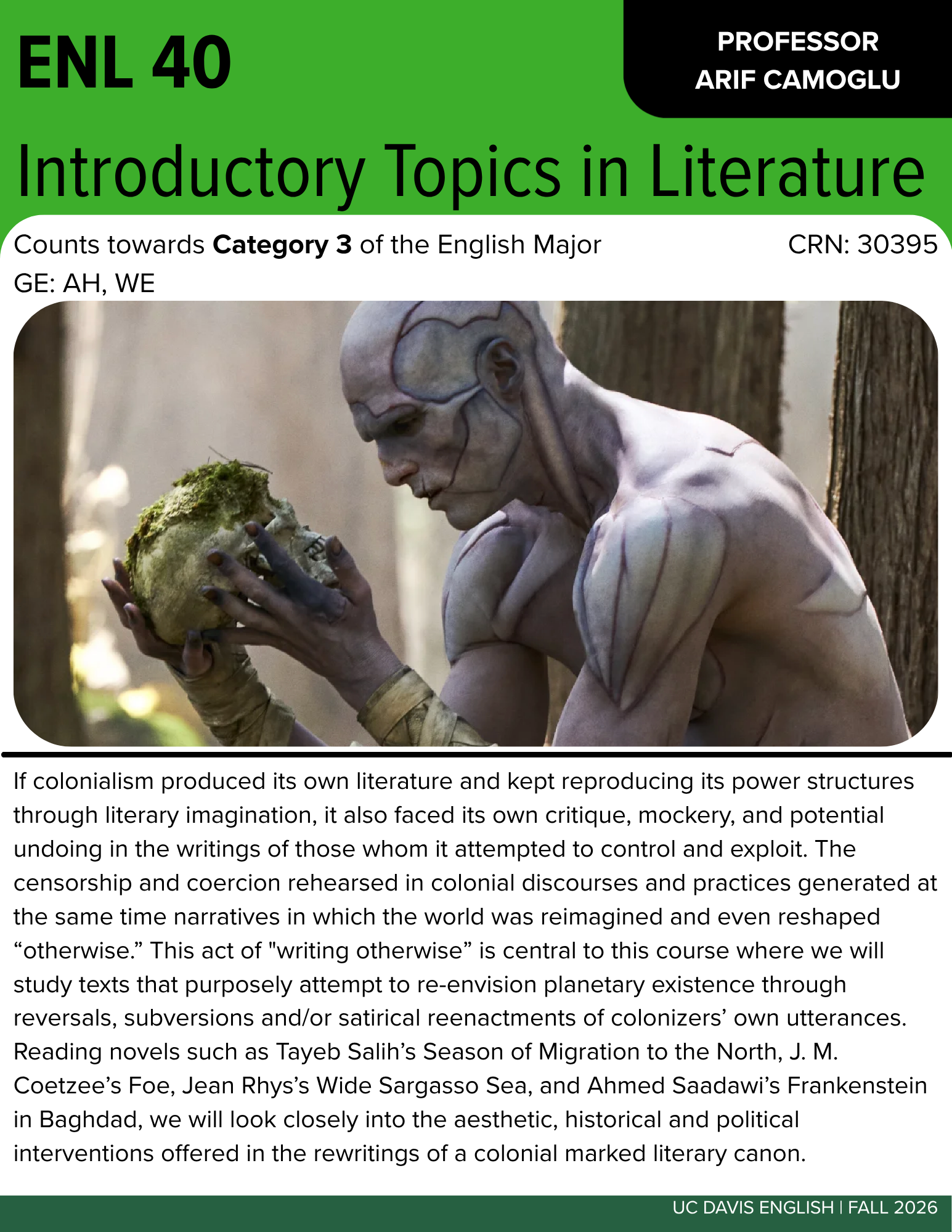
If colonialism produced its own literature and kept reproducing its power structures through literary imagination, it also faced its own critique, mockery, and potential undoing in the writings of those whom it attempted to control and exploit. The censorship and coercion rehearsed in colonial discourses and practices generated at the same time narratives in which the world was re-imagined and even reshaped
"otherwise." This act of "writing otherwise" is central to this course where we will study texts that purposely attempt to re-envision planetary existence through reversals, subversions and/or satirical reenactments of colonizers' own utterances. Reading novels such as Tayeb Salih's Season of Migration to the North, J. M. Coetzee's Foe, Jean Rhys's Wide Sargasso Sea, and Ahmed Saadawi's Frankenstein in Baghdad, we will look closely into the aesthetic, historical and political interventions offered in the rewritings of a colonial marked literary canon.

ENL 41
TOPIC: Forms of Trauma
This course explores representations of trauma across various genres of literature and media. In each case, we will consider how and why trauma can foster both debilitating stasis and alienation as well as opportunities for growth and belonging. A key feature of the course will involve examining how texts communicate trauma through their formal attributes (genre [un]convention, structure and sequencing, narrative devices, linguistic tools, etc.), revealing aspects of loss, remembrance, and grief that can only be expressed through such techniques of form. Content warning: this course involves reading, discussing, and writing about disturbing materials, including instances of physical and emotional abuse, sexual violence, and suicidal ideation.

ENL 42
This course will present some different ways we can approach reading literary texts. We will do so by focusing on three literary texts: William Shakespeare's The Tempest, Christina Rossetti's "Goblin Market," and Nella Larsen's Passing. We will spend time interpreting each text with reference to a variety of literary terms. Then, we will read articles about the literary text that offer different interpretive approaches.

ENL 46
Are you a writer? Take this class and you will be. In English 46, you will write weekly assignments and a final project (no midterm or final exam). Our reading focuses on well-written essays, stories and poems that make mental states like memory, dream, delusion, and wonder come alive, focusing on Nobel-prize winning Korean writer Han Kang's The Vegetarian, and including works by Jamaica Kincaid, Louise Gluck, Virginia Woolf, Pam Houston and Franz Kafka. Writing assignments will range between genres. No experience necessary - this is a class for everyone who wants to write. We will operate as a dynamic, creative laboratory space, interspersing generative writing with lectures. Sections will function as mini-workshops.
Grading will be based on weekly writing, weekly workshop participation and a final project, with abundant opportunities for extra credit offered throughout the class.
Reading: Han Kang, The Vegetarian

ENL 52
The theater stage has always been a popular medium for Shakespeare’s plays, and the plays have also been reimagined for other media, especially film and video. Today, Shakespearean drama is transposed to just about every media form imaginable, and this great range of popular culture adaptations is the focus of our course. We’ll explore how Shakespeare’s plays are rendered on screen (via television, film, social media, and videogames) and off-screen (comic books, music, and board/role-playing games). How does reenvisioning Shakespeare for popular audiences and through different media forms affect the meaning of Shakespeare’s plays? How can Shakespeare help us think anew about popular media that we use every day? How does transposing the plays to these popular media enable the plays to address wider, more diverse audiences, and to speak to human differences such as those relating to gender, race, ethnicity, sexuality, religion, socio-economic status? How can adaptations of plays performed 400 years ago in England help us think about issues important to us here and now?

ENL 59
This course will consider how literary works by BIPOC (Black, Indigenous, and People-of-Color) authors have framed and responded to specific historical contexts of racial and colonial violence—such as slavery, colonization, imperial wars, forced migration, labor exploitation, and environmental injustice. Our focus will be on comparing forms of racial and colonial violence: not only the different forms that violence and inequity can take, but the different ways that authors have repurposed literary forms (for example, the novel, speculative fiction, lyric poetry, and film) to do justice to experiences of violence that range from microaggressions to environmental toxicity, from the “afterlife of slavery” to cultural genocide. Further, how do literary works explore and enact modes of resistance, community formation, and/or futurity in the wake of racial and colonial violence? We will put literary concepts in dialogue with concepts drawn from interdisciplinary scholarship, including trauma, microaggression, criminalization, settler colonialism, and Indigenous resurgence. Through readings, discussions, and writing assignments, the class will explore conceptual frameworks for understanding how different contexts of racial violence (as well as its inter-articulations with other aspects of identity such as class, gender, sexuality, and ability) inflect psychological, historical, and social aspects of everyday life, as well as how these conditions of experience shape—and are shaped by—literary form.

ENL 111
This class will consider a broad sweep of medieval English literature, from roughly 900-1500, through the cracked mirror of monstrosity. The goal of this class will be to learn how to engage with the literatures and material culture of the Middle Ages by reading through some of its fears and unconscious desires, where medieval writers invite you off the map and into the unknown. We will be looking at a variety of genres from sagas to lais to romances to drama. Through this we will see how medieval writers thought about what constituted the human, how they engaged with peoples beyond their known world, and how they imagined alternative futures through monstrous bodies. Ultimately we will consider the lingering presence of the Middle Ages in our lives, as we continue to harbor some of the same anxieties and terrors derived from our encounters with those early writings.

ENL 130
The romantic age was a "restless" one. Industrialization, enclosures, political censorship, colonialism, slavery and slave trade, and revolutions across the world left their marks on the literature of the time. It was this tumultuous history that romantics attempted to capture or escape in their writing as they came up with concepts like "organic unity" and "negative capability," and engaged with politicized aesthetics such as Orientalism and Philhellenism. That is to say, the "restlessness" of the romantic age had deep poetical, philosophical and political dimensions which had "empire" at its core. In this course we will learn about these different yet interconnected layers of romantic imagination in relation to empire, as we read poems, essays, novels and travelogues by wellknown and understudied authors of the age.

ENL 139
Going ‘back’ to Africa has been a vexing theme – at times uplifting, at others mournful, and others spiritual – since the beginnings of various African diasporic literary traditions. Recent waves of African diasporic emigration and tourism to Africa suggest that this theme enjoys considerable contemporary resonance. In this course, we will explore a range of twentieth-century African and African-diasporic literature, music, and film that contemplates the realities, implications, and impossibilities of returning to the ‘Africa’ various travelers seek. We will pay particular attention to historical moments that intensified dreams, political movements, and cultural production of African and African diasporic peoples surrounding questions of return; we will also turn our attention to contemporary currents and conversations. Throughout, we will ask, what did Africa mean to thinkers, travelers, revolutionaries, and everyday people in each of these moments, and, what does and can Africa mean to us today?

ENL 166
This course will examine the “lover’s discourse” of twentieth- and twenty-first- century American poetry. We will consider how poems represent the various states and stages of eros through different genres, tropes, and figures. We will also explore the necessarily political and cultural valences of love, from queer intimacies to ecological interrelation to revolutionary desire. And we’ll think, as well, about how various poems portray the ends of love, what philosopher Roland Barthes calls its “last words.” This course is intended to teach students about the forms and modes of representation central to the traditions of love poetry, focusing sustained attention on key forms such as sonnets, elegies, odes, lyric, and epistolary poems and on central techniques such as apostrophe and blason. At the same time, the course will explore the innovations of modern and contemporary North American poetry, as poets experiment with old forms and invent new ones to write of the manifold experiences of love in a changing world.

ENL 169
In this class, we will examine several contemporary works of memoir and life writing from different genres including personal essay, creative non-fiction, graphic memoir, and poetry. Among other questions, we will examine the ways that these writers, authors, and poets expand and transgress the boundaries of life writing and memoir. At the same time, we will interrogate whether the typical terms often applied to this style of writing and poetry are useful or relevant, as well as how the genres of writing shape the representation of the self. We will also consider how "ethnic," queer, and women's narrative and poetry have historically been conflated with both "self" and
"community," even as they have also rejected these associations at times. We will examine the way that these texts focus on hybrid genres and forms of writing and representing and/or performing the self. And spoiler: Not every text we will be reading is a memoir in the traditional sense.

ENL 184
How do we sense the environment, and how might we sense it otherwise? How has the Western privileging of vision and hearing influenced understandings of “nature,” and of what kinds of environments need to be protected? How can writers and artists help retrain our sensory capacities so that we might perceive and attend to invisible environmental processes—and injustices—that often escape perception? And how can “lower” senses like touch, taste, and smell teach us to experience ecological relationships in different, more embodied ways? This class will consider how Western, colonial, and patriarchal hierarchies of the senses constrain our environmental relationships, and how literary and cultural experiments with the senses critique and seek to transform our ways of sensing the world. In addition to exploring supposedly “lower,” embodied senses, we will consider speculative fiction that imagines alternative ways of sensing.

ENL 187A
This course grows out of a partnership between the English Department and three research groups at UC Davis: The DataLab, the ModLab, and the Center for Artificial Intelligence and Experimental Futures. The course examines how recent technologies such as artificial intelligence (AI), mixed reality (MR), and virtual reality (VR) are shaping the experience of Shakespeare for 21st century audiences. Students will not only read about, but experience first-hand a number of interactive projects that use digital technologies to stage--or enable their users to stage--Shakespeare’s plays. What are the limitations and affordances of these technologies for reimagining Shakespeare in the 21st century? To what extent do these technologies help us gain new insights into Shakespeare’s plays? How are experiments with interactive media changing more traditional ways of experiencing Shakespeare in classrooms, theaters, popular media, and public spaces? Are these changes beneficial and, if so, for whom and why? A more practical aim of this course is to help students think about how a passion for Shakespeare could be channeled into career paths where new technologies have been gaining traction: K-12 teaching, theatre production, game-making, and academic scholarship. To that end, students will focus their term project on a career path that most interests them. For instance, those on a teaching path might create course materials for teaching Shakespeare with new technologies or assess our own course’s approach to this topic; those on a game-making path might prototype a game designed to be played using one of these technologies; those on a theatre path might write a pitch or script for a theatre production that uses a particular technology to re-envision a Shakespeare play; those on a scholarship track might write a research essay examining one or more existing interactive Shakespeare projects. Students do not need any background or familiarity with VR, AI, and MR technologies in order to take this course. They just need to be open to experimenting with interactive media.