


New Books by UC Davis English PhD Alumni
New Books by UC Davis English PhD Alumni
The second part of a three-part series by Heather Ringo interviewing UC Davis English PhD program alumni, this article follows four former students who published groundbreaking books after completing their degrees. These authors reflect on their warm (and sometimes humorous) memories at UC Davis and how their time here laid the foundation for their books. Finally, they offer sage advice for those seeking to follow in their footsteps.
by Tom Lin | Assistant Professor in the English Department at the University of Iowa

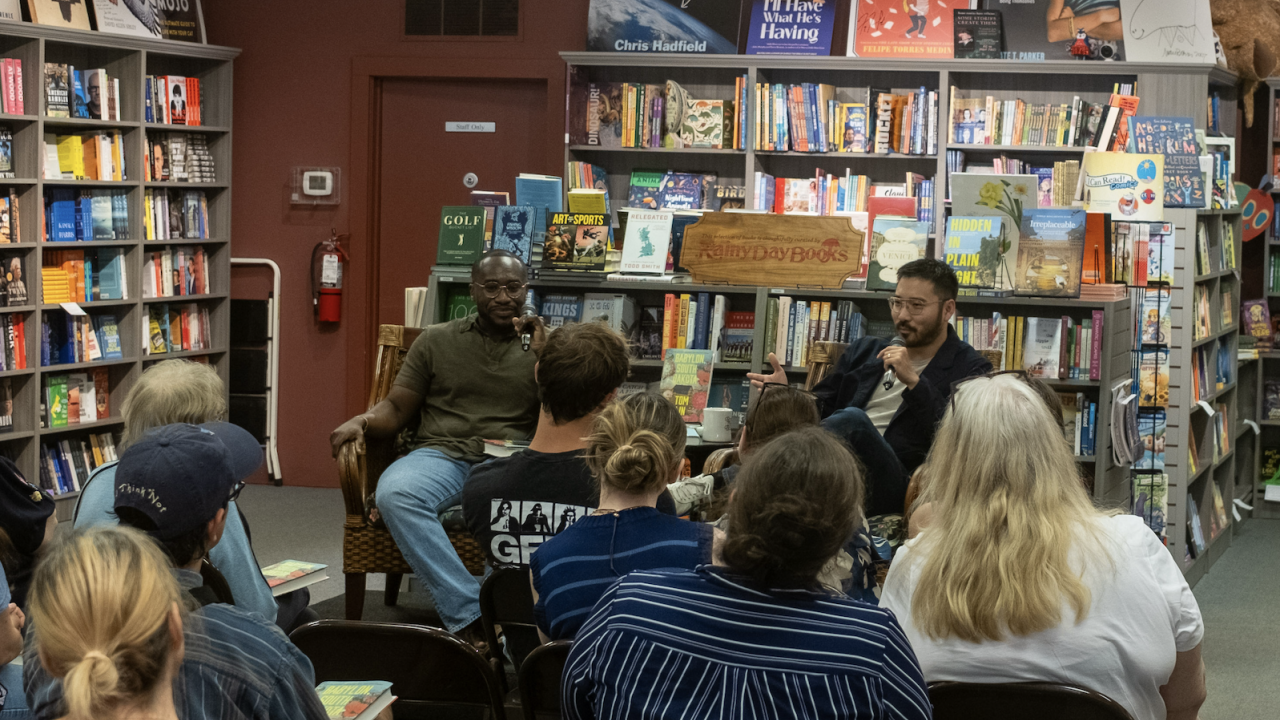
You stated in an interview with Chancellor May back in 2022 that you wrote your first award-winning novel, The Thousand Crimes of Ming Tsu, in the weeks before beginning the English PhD program at UC Davis. Impressive! But then you had to do all the author stuff — readings, interviews, award ceremonies, basking in the adulation of your fans — on top of graduate school. How did you balance your novelist role with completing your graduate studies?
The media circuit for the first novel was largely virtual, since Thousand Crimes was published during the Covid pandemic, and so many of my memories juggling graduate study and a burgeoning career as a novelist are quite boring—logging into a Zoom interview for an hour, leaving that meeting, and then going straight into another Zoom meeting to teach a class. In the winter quarter of 2022, I was in my shared office in Voorhies answering emails when my cell phone rang. It was my editor, Ben George, calling to tell me that I'd won the Carnegie Medal for Excellence in Fiction. Cell service in my corner of Voorhies was atrocious and I remember cranking open the window to try to get a better connection. When the call was over I texted the news to Pia, my then-girlfriend, now wife, and then put my phone on Do Not Disturb—I had to run across campus to teach UWP 1!
Tell us a little bit about your new novel, Babylon, South Dakota. What are you most excited for readers to experience with this story?
The new novel is a story of a Chinese American immigrant family that moves to an inherited homestead in South Dakota to build a life in a new country. Not long after their arrival, the US government purchases an acre of their property to build a nuclear missile silo. From there, strange things begin to happen. I hope that readers will love the characters in the novel as much as I loved writing them, and I hope that they'll leave the book with the same feelings of awe that inspired the novel in the first place—awe at nature, at the works of man, and at the ties that bind us to one another.
Where can we see the influence of your time at UC Davis in either of your novels?
The second novel directly builds on research into nuclear missiles that I conducted for my dissertation, and in many ways I view it as a sister work to the dissertation; I have long thought of critical and creative writing as two approaches to the same problem, which is that of articulating the ineffable using the coarse instruments of language. My dissertation examined the ways that science fiction and popular culture participates in the shaping of complex technologies, such as the nuclear missile. As I went from launchpads in Florida to archives in San Diego, I realized that the questions motivating my doctoral research were also available to fiction. The new novel owes its existence, framing, and substance to the research and thinking I did during my time at Davis. It is particularly indebted to many fruitful conversations I had with Professors Colin Milburn, Finn Brunton, and Gerardo Con Diaz.
Congratulations on your new Assistant Professor role at the illustrious University of Iowa! What are you teaching nowadays?
Thank you! Each semester thus far I've taught a course on craft and method in creative writing—focusing on various themed topics such as nuclear weapons, corporations and capital, and immortality—as well as a small fiction workshop. The students are incredible and I get excellent cell service in my office. The Midwestern winters are almost unbearable and are said to build character.
What advice would you give to those hoping to follow in your footsteps?
Finish what you start! As writers (critical and creative) we are easily distracted by the excitement of the new project. And it is always easier and more fun to work on something new than it is to toil away at the thing-in-progress, particularly if that thing-in-progress has begun to give you a hard time. I think that finishing something is as much a skill as any other—and, as such, it is also something that can be practiced and improved. Bringing a project to a close, however unsatisfying or imperfect, is such an enormously instructive experience that you simply can't get through any other means.
by Sara Petrosillo | Associate Professor of English/Director of the Gender, Women’s, and Sexuality Studies Program at the University of Evansville
This interview is dedicated to the memory of Joshua Clover.
Any highlights or fond memories of your time at UC Davis you would be willing to share?
So many. A few are: Latin parties at Emily Albu’s incredible house; working with special collections to create teaching archival exhibits for my classes; learning how to read medieval script from Sally McKee; attending Battle of the Bands and Picnic Day. Within the department, I got to take a sequence of courses with Liz [Miller], John [Marx], and Seeta [Chaganti] that all were meant to complement one another and that was such a great experience.
But the most important memory was my experience living in the former graduate student housing complex, Solano Park. This was a true community that offered such understanding and care. Members of our department (who didn’t even live there) even stepped in to help protest and keep the complex open for years after it was supposed to close.
Could you tell us a little bit about what led to the idea for Hawking Women? And the process of ushering it into creation?
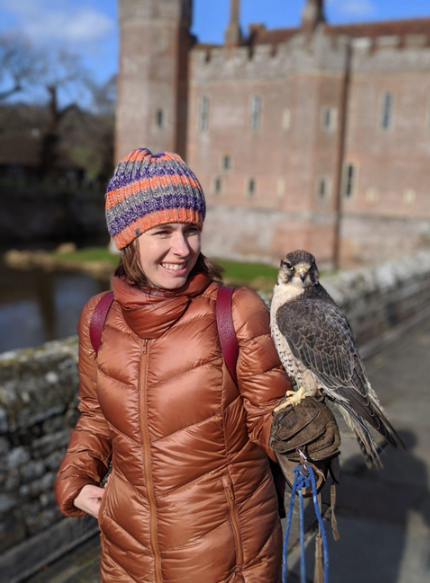
I think if you ever see a hawk perched on a branch or a power line by the side of the road and you kind of hold your breath waiting for it to take off just to catch a glimpse of its flight, you know how easy it can be to be mesmerized by these creatures. Part of medieval education included hours spent close to hawks, training them, recalling them to the glove, and learning how to accommodate them by changing small things about one's own body and movements. Imagining the Middle Ages through this proximity to hawks really made every textual reference one of those breath-catching moments for me. And the idea that female hawks are always the larger and more dominant of the species is just such a tantalizing invitation to defamiliarize control in gendered relationships, especially those relationships in medieval literature that are described through falconry metaphors.
In terms of turning this research into a dissertation and then into a book, I spent a lot of time with medieval romance and poetry, with hunting manuals and poetics treatises, with my advisor and committee, and with the birds and their handlers. I was very grateful to be awarded grant funding to take an apprentice course with falconers at West Coast Falconry in Marysville, California. And I made great friends with falconer and golden eagle handler Jack Hubley in Pennsylvania, and some falconers in Italy and England as well. Gaining the material experience helped me understand the texts and descriptions of training and notice things I wouldn’t have without meeting both the birds and their dedicated handlers.
Where can we see the influence of your time at UC Davis in the book?
I think both the location of Davis and the people are all over this book. I lived down the bike path from the California Raptor Center and would bike there all the time with my family. And Davis’s proximity to the Sierra Foothills made that falconry apprentice workshop possible. But the biggest influence of my time at Davis can be seen in the way my oral exams challenged me to think through hard questions in this project. Seeta Chaganti, Noah Guynn, and Claire Waters were a dream team of a committee, and they helped me turn bursts of close readings into carefully translated and theorized arguments that still held when I turned my dissertation into a book. Margie Ferguson believed in me and helped me think about what the next project would be and how to connect what I was doing with Hawking Women to a project on medieval reproductive health. But Joshua Clover was the one who taught me why poetics matters. When I approached him to serve on my Qualifying Exam committee, I knew that preparing for his questions would push me beyond ready articulation— I knew I might stumble or just not yet figure it out in the exam. And it’s because of his questioning that I was able to take that dissertation and revisit those questions and turn it into a book. If it’s ok, I’d like to dedicate this interview to him.
What was it like adapting from graduate student at Davis to tenure-track professor at the University of Evansville?
UC Davis prepared me so well! Being a teaching assistant, teaching UWP, and then teaching a fuller load for a year as a post-doctoral instructor and a year as a visiting assistant professor at a small liberal arts college in Pennsylvania gave me so much material to begin with in my tenure track job. I got to design a course for UC Davis English majors and the prompt was: “What is one course you wish English majors would have before they graduate?” It was ENL 165, Topics in Poetry and I called it "Ovid and the Poetry of Translation.” We read translation theory and Ovid’s Metamorphoses plus a lot of medieval to modern translations. It is still my favorite course, and I continue to teach a version of it.
I’m very lucky to have a lot of flexibility and academic freedom with my course materials. UC Davis prepared me to hold those values dear and to fight for them. I teach a class on "Premodern Trans Lives and Postmodern Gender Theory" and I became the director of the Gender, Women’s, and Sexuality Studies Program—designing a course like that and taking on that role was something I dreamt about as a graduate student. At the same time, there are a lot of time constraints and meetings which require time to adapt. There’s a balance between wanting to be involved and serving the community and making time to make sure I’m still writing and using my imagination to dream up new classes or conference ideas.
What advice would you give to someone aspiring to follow in your footsteps?
The most surprisingly useful practice I did while I was in the thick of dissertating was to continuously “translate” the arguments of my chapters to non-academics. This led to some arguments about why the topics I was studying mattered— which is a line of defense I am using all the time now. I practiced doing this in another language as well, which really helped me distill what I was trying to argue.
by Ryan Tan Wander | Assistant Professor of English at Valdosta State University

Would you be willing to share some highlights from your time at UC Davis?
I honestly don’t know if there is a better or more supportive place to develop as a scholar and teacher than in the UC Davis English Department. My experience in the Ph.D. program was defined by an almost magical mix of rigor and collegiality. My cohort contained some of the brightest and kindest people I’ve met in my life. The time I spent and the relationships I've built with Hsuan Hsu, Mark Jerng, and the late Beth Freeman are dearly important to me.
I often think, with a great deal of fondness, about two meetings that took place in Hsuan’s office. The first was when I was trying to figure out the art of writing a proposal to present at a conference—a task that seems so familiar to me now, but which seemed quite daunting then. I met with Hsuan and he walked me through the process, and I just remember feeling like I was in the best of hands. The other moment that comes to mind often is a meeting that I had with Hsuan, Mark, and Beth. It was the first whole-dissertation-committee meeting after my qualifying exam, and I walked out of that meeting feeling like these three brilliant, highly accomplished scholars really believed in me and were committed to the work of challenging me to do my best work. Throughout my experience at UC Davis, I was cared for, respected, and challenged in the best possible ways.
Congratulations on your book, Settler Tenses! Can you tell us a little about the book?
Yes, I’m very happy to say a bit about Settler Tenses. The book traces the crystallization of settler colonial temporalities and sexualities in white male authors’ portrayals of the American frontier across the late nineteenth and early twentieth century. I focus on Westerns, literary naturalism, and regional writing and argue that authors including Bret Harte, Jack London, Frank Norris, and Owen Wister constructed literary chronotopes that amount to queerly settler colonial responses to the temporal imperatives of the U.S. settler state. Writing in a crucial late nineteenth and early twentieth-century period of U.S. settler colonial consolidation, these white male authors coopted temporalities assigned to gendered, racial, and sexual others to tell stories in which not one but many timelines pointed to essentially the same outcome: the ascendance and permanence of a normatively white settler society. I hope that readers take away from the book an understanding of how U.S. settler hegemony since at least the late nineteenth century has been about incorporating the queer timelines and orientations of settler colonialism’s abjected others. Settler hegemony, in other words, has been about protecting the turf on which cisgender heteronormative white men reign by claiming for these men the very orientations to time, history, and futurity that subject some bodies to violence and relegate some populations to extinction.
Where, if anywhere, can we see the influence of your time at UC Davis in Settler Tenses?
Settler Tenses has the UC Davis English Department and humanists and social scientists from across the Davis campus in its DNA. Of course one’s scholarship is ultimately a collective enterprise insofar as it’s influenced by the work of scholars from many locations across the globe (not to mention from many different historical moments). Settler Tenses began with the research I did at UC Davis as I wrote my dissertation, and even though the book is the result of a lot of revision and reconceptualization that took place after my time at Davis, I see a lot of the Department and the University—and a lot of Hsuan, Mark, and Beth in particular—in its pages. Without Hsuan, I may never have thought so deeply about the prose forms that compose the book’s archive and animate the book's theoretical and methodological investments. Without Mark, my understanding of genre and genre studies would be much impoverished. And without Beth, I don’t think I could have written a book ambitious enough to name and theorize the concept of “settler tenses” referenced in the title. All three of them taught me how to be at once bold and rigorous in my scholarship.
What part of your research for the book was most exciting for you, and why?
It’s actually hard to say which part was most exciting. I don’t think I’m simply being nostalgic in saying that researching and writing my dissertation was one of the most fulfilling and fun things I’ve done in my life. Perhaps the most memorable moment of the whole process came early on, when I was doing the research for what turned into a chapter on pulp Westerns. I started to really enjoy the combination of formula and chaos that runs through those novels. Texts that are deeply entertaining and also very productive objects of scholarly inquiry? I was hooked.
Congratulations on your new Assistant Professor role at Valdosta State University! What are you teaching nowadays?
Thank you! Right now I’m teaching the Department’s Senior Seminar, a survey class on Multiethnic Literatures of the United States, and a class that uses relational race studies to read Asian American and Native American literatures. In the Senior Seminar, I get to work with students who are doing really cool and innovative projects on topics ranging from Herman Melville's “Bartleby” and the rhetoric of law to Ryan Coogler’s Sinners and oral tradition. The class on Asian American and Native American literatures allows me to expose advanced undergrads and master’s students to what I think is some of the most exciting and cutting-edge interdisciplinary work happening these days. It is truly a privilege to work with my students.
What advice would you give someone who hopes to follow in your footsteps?
Persistence is key. And surround yourself and work with the people who seem most invested in helping you to succeed and get your ideas out to the scholarly communities you wish to join. I’m also an advocate of taking on challenges that might seem a bit too far outside the orbit of one’s expertise. If you’re an exceptional undergraduate student, or if you’ve already made it through the very narrow gates of admission to a humanities Ph.D. program, you’re likely very, very smart and talented. Don’t be timid; take on the challenges that seem just a bit more difficult than you think you can handle, because that’s where you’ll grow as a scholar, teacher, and professional.
by Gina Caison | Kenneth M. England Professor of Southern Literature at Georgia State University
Any highlights of your time at UC Davis you would be willing to share?
There are surely too many to name, and I don’t want anyone to feel slighted by me not mentioning them. However, I can say that the peer writing and research groups I formed while at Davis have continued to enrich my life in so many ways. In addition to my official mentors, I found so many professors willing to support me with their guidance. Hardly a week goes by that I do not talk to or text with someone I became friends with while in graduate school. I continue to consider many of my peers as the best first audience for my ideas. There’s a trust there that I think only graduate school can create.
You published your first award-winning book, Red States: Indigeneity, Settler Colonialism, and Southern Studies after you graduated from UC Davis. This book analyzes how settlers in the U.S. South inaccurately imagined and narrativized Indigeneity, and how Indigenous people pushed back against settler misconceptions. What is the relationship between this book and your dissertation at UC Davis?
This book was drawn largely from my dissertation. The organization was entirely different because I realized that the larger point I wanted to make was about how key narratives are re-told over time. I also realized that I had a lot to say about a few contemporary texts I had needed to set aside during the dissertation process due to time constraints. The most important part of my revision process was working with fellow junior scholars who were at the same place in their careers as I was. Writing and thinking in community has always been a large part of my work.
Your second book, Erosion, examines how settler “concerns over [soil] erosion reveal anxieties of disappearance that are based in the legacies of settler colonialism.” What was the experience like writing a second book compared to the first?
For me the second book was a much easier process than the first. I quickly felt like I understood the book I wanted to write, and I was able to use the skills I had learned in graduate school to map out a process that worked for me. I made myself a reading list not unlike a comprehensive exam list, and from there I started to think about how the book could be organized to execute my argument.
I always have a hard time saying what part of my own work I am most excited about. Because I grew up in North Carolina, the last chapter where I am able to use knowledge I learned in high school while working on a coastal erosion project does feel the most personal and full circle for my own intellectual development.
California features a starring role in one of the chapters of Erosion. And UC Davis professors get a shoutout in the Acknowledgements. Where can we see the influence of your time at UC Davis in the book?
The first chapter could not have been written if I had not lived in California and had not worked with the wonderful professors in the Departments of English and Native American Studies. I have always tried to write about places I have lived —even if for a short time— because I tend to think that the ability to critique certain structures ultimately must come from a place of care. There are few better ways to care about a place than to live its daily rhythms and to feel accountable to people who call it home.
What advice would you give to someone aspiring to follow in your footsteps?
I think that the most important thing a young scholar can do is to listen to that voice that drives their passion. There are too many lonely days at the keyboard if you aren’t absolutely obsessed with figuring out the answer to your “problem.” I also think it’s fair to let ideas “bake” for a minute. A cake that is cooked faster does not yield a better cake. On the other side of that, though, is the truth that an over-baked cake is also not great. You have to give yourself the grace of knowing how long it might take to bake the cake, and at the same time, you have to keep an eye on it. It’s a hard balance to find when you’re first starting out. However, if you’re truly invested in your core research questions, the time it takes is rewarding even if it isn’t always “fun.”